

/https%3A%2F%2Fcdn-tor.buminteractif.com%2F2026%2F09%2Fa3fd2083-95b5-4570-b123-c88d6dd70fcf.jpg)
Now that we've covered our top 15 most promising CH prospects, it would be good to revisit some summer topics that we've put on the back burner.
Here are three questions that still deserve some thought and answers before the next season kicks off! There are plenty of others, but hey, we have to keep it short…
So let's start with two quick appetizers before tackling THE big question as the main course!
1. Who will replace Brendan Gallagher as assistant captain?
The answer to this question could be revealed as early as September 15 at the Montreal club's official golf tournament.
Who will be chosen?
As is often the case with “big philosophical questions,” there are “several possible good answers”… but some are definitely better than others!
Grant McCagg recently made a strong case for Juraj Slafkovsky, arguing, among other things, that Slafkovsky would benefit as a player from an increased leadership role on the team. That could help him take his game to yet another level. Not a bad point. Really not a bad point. Among other things, Slaf demonstrated his leadership qualities when he was moved to the second line, which he immediately took charge of. We also know the influence he wields on the Slovak national team.
It's not impossible… But has he already reached the required level of maturity?
By the way, McCaag believes that Lane Hutson, for his part, wouldn't need an “A” on his jersey at all to become a superstar—which he already is.
Cole Caufield is another name often mentioned—he's very vocal and cheerful in the locker room…
Personally, I might lean a little more toward Lane Hutson, if only for his phenomenal work ethic and his visceral hatred of losing. A role model.
But it's also VERY POSSIBLE that the Habs will simply decide to continue what they already started when Gallagher wasn't on the roster last year: giving the “A” back to Josh Anderson. Anderson will be in the final year of his contract, and that would give the young candidates a little more time to learn the ropes and let things fall into place a bit more “organically” in the locker room, to use a buzzword…
2. Speaking of which, why didn't they sign Josh Anderson to a new deal this summer?
Short answer: There was no rush!
Long answer: The rugged Anderson will turn 33 next May, and it's wise for the Habs to give themselves time to properly evaluate certain young players in the organization (Florian Xhekaj, among others) before offering him a new contract. We'll also be able to better assess his health in the spring of 2027…
Otherwise, despite minor and not-so-minor injuries here and there, Anderson hasn't missed many games over his first six seasons in Montreal. He's been consistent in his own way, recording between 20 and 32 points annually and about 15 goals.
The player we saw last year is no less talented than the one Bergevin acquired in the fall of 2020 in exchange for Max Domi, and players like that aren't easily replaced.
That said, his responsibilities—already fairly modest—are likely to be reduced even further in the coming months or years if he continues his career in Montreal. For example, he might lose his spot on the penalty kill to someone like Juraj Slafkovsky…
3. Will the Canadiens be better or worse next season?
Ahhh! Finally, THE big question!
How many times have we read and heard that the Habs regressed or stood still over the summer by losing the services of Gallagher and Joe Veleno while failing to sign any NHL-level players?
Things would have been different if Michael Hage had decided to start his pro career with the team, but that option will now have to wait—unless they decide to trade the young player.
Don't bet too much on that…
That said, if we rephrase the question slightly, we should instead ask: Is the Habs more likely to be better or worse?
Let's analyze a few key factors: injuries, goaltenders, Lane Huston, and… Derek Lalonde!
Injuries
The Canadiens were relatively spared from injuries last year and finished the season with a respectable 106 points.
But let's not forget that they still lost the services of three key players—Kaiden Guhle, Kirby Dach, and Alex Newhook—for about half the season each. That's not something to overlook. Dach and Newhook were on hot streaks when they got injured…
According to hockeystats.com, the combined WAR (wins above replacement) of these three players is 1.79: (1.23, Newhook) + (0.31, Dach) + (0.25, Guhle).
Let's round it up a bit—and say two more wins, for a total of 4 points.
That seems very reasonable and realistic to me.
Goaltenders
The Habs also stubbornly kept playing Samuel Montembault until March, losing a LOT of standings points in the process.

Dobes' WAR was 4.98 and Fowler's was 2.65, while Montembault's was only 0.66. So, technically, Montembault didn't win a single game for the CH last year—at most, he contributed a single point—while the spectacular performance of the Dobes/Fowler duo would have won the team no fewer than 7 games and earned it approximately 15 points.
If you split Montembeault's 25 games between Dobes and Fowler, you'd probably end up with 3 to 5 more wins, right?
Let's split the difference and say 8 more points.
Lane Huston… on the right
Others might also argue that he may have left other points on the table by playing Lane Huston on the right wing, for lack of a better option. Perhaps his WAR—already not too shabby at 7th among all NHL defensemen—could have been around 4.08 instead of 3.08 had he played on his strong side with a good partner all season.
One more win, two points…
So, if I understand correctly, statistically, mathematically, and theoretically, that's roughly—potentially—14 points the Habs might have lost due to these three factors last year.
Well, of course, you have to take some advanced statistics with a grain of salt, and I don't claim to be an expert on the subject.
But looking at it more “realistically,” what do these three factors amount to—about ten lost points?
That would have been more than enough to win the division—or even the conference. The Sabres finished the season with 109 points, the Hurricanes with 113…
Of course, every team faces factors that cost them standings points every season. The Canadiens will undoubtedly have more injuries, and perhaps to key players. Furthermore, there's currently no guarantee that the situation will improve defensively or in goal, or that Suzuki, Slafkovsky, Hutson, and Caufield will all have equally strong seasons.
But if I had to bet a few dollars, I'd say the Habs have a better chance of improving in most areas than they do of regressing—and therefore of picking up a few more points.
Not to mention that they're still the youngest team in the NHL. Their potential for “organic” growth (we just can't seem to escape this term!) is therefore still among the highest in the entire league.
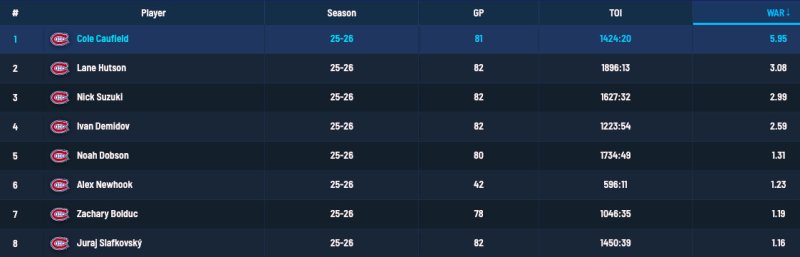
For example, can Slaf improve his modest WAR of 1.16 to a level closer to Suzuki's 2.99?
Very likely.
Will Demidov be able to improve on his already very good 2.59?
A very good chance.
The “big signing” of the summer
Finally, from a team-wide perspective, let's not forget the arrival of assistant coach Derek Lalonde—arguably the biggest signing of the summer—who will certainly help shore up the defensive structure and penalty kill, major weaknesses from last season.
We're joking, but Lalonde might end up with a pretty decent WAR by the end of the year! We didn't bring him to Montreal thinking he'd be any worse in his role than Trevor Letowski…
How many more wins will a better defensive structure bring the team?
At least 3–4, right?
In short, logic dictates that the Habs will improve again—at least a little—this season.
Even without having made (yet) any major changes to its lineup.
